Metric system andDrug Dose Calculations Ch 2
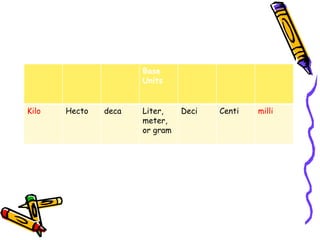
Base Units Kilo Hecto deca Liter, meter, or gram Deci  Centi milli
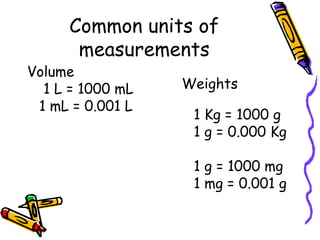
Common units of measurements Volume   1 L = 1000 mL 1 mL = 0.001 L Weights 1 Kg = 1000 g 1 g = 0.000 Kg 1 g = 1000 mg 1 mg = 0.001 g
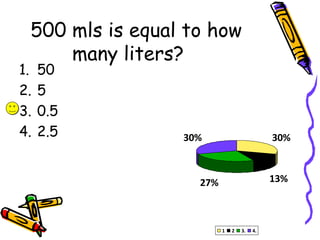
500 mls is equal to how many liters? 50 5 0.5 2.5
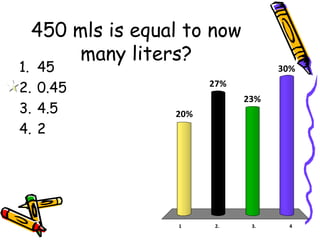
450 mls is equal to now many liters? 45  0.45 4.5 2
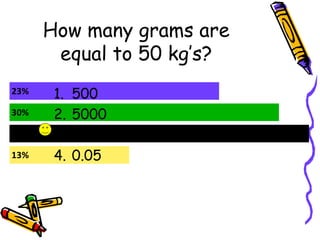
How many grams are equal to 50 kg’s? 500 5000 50000 0.05
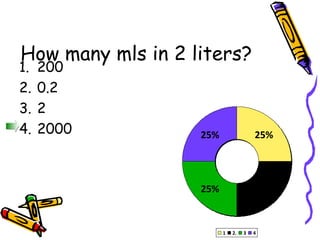
How many mls in 2 liters? 200  0.2  2 2000
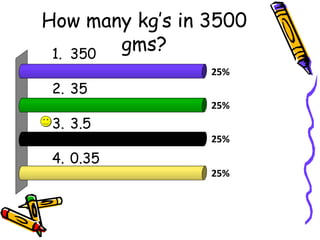
How many kg’s in 3500 gms? 350 35 3.5 0.35
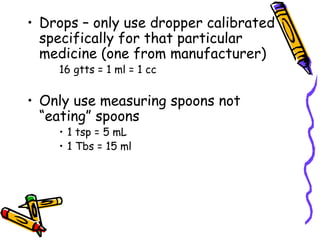
Drops – only use dropper calibrated specifically for that particular medicine (one from manufacturer) 16 gtts = 1 ml = 1 cc Only use measuring spoons not “eating” spoons 1 tsp = 5 mL 1 Tbs = 15 ml
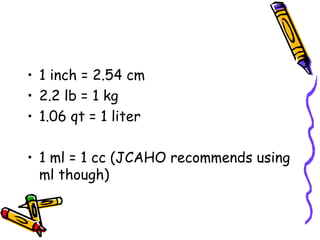
1 inch = 2.54 cm 2.2 lb = 1 kg 1.06 qt = 1 liter 1 ml = 1 cc (JCAHO recommends using ml though)
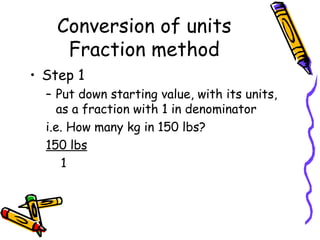
Conversion of units Fraction method Step 1 Put down starting value, with its units, as a fraction with 1 in denominator i.e. How many kg in 150 lbs? 150 lbs 1
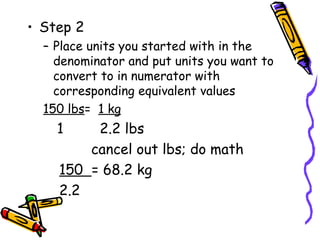
Step 2 Place units you started with in the denominator and put units you want to convert to in numerator with corresponding equivalent values  150 lbs =  1 kg 1   2.2 lbs cancel out lbs; do math 150  = 68.2 kg 2.2
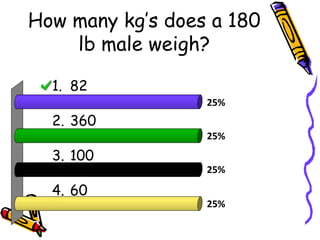
How many kg’s does a 180 lb male weigh? 82 360 100 60
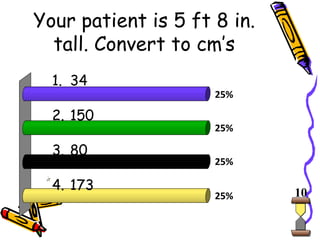
Your patient is 5 ft 8 in. tall. Convert to cm’s 34 150 80 173 10
Calculating doses from  percentage-strength solutions A solution contains a solute, which is dissolved in a solvent.  The strength of a solution is expressed in percentage of solute to total solution.  The % is the part of the active ingredient (solute) in a 100 mL of the preparation.  We usually use a weight to volume type of preparation for respiratory drugs.
A 20% saline solution contains 20 g of salt in enough water to make 100 ml of solution A 5% albuteral solution contains 5 ml of albuteral in enough water to make 100 ml of solution
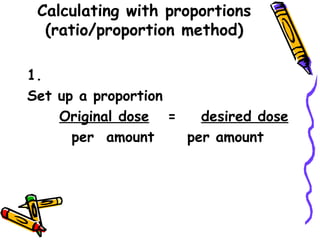
Calculating with proportions (ratio/proportion method) 1.  Set up a proportion Original dose   =  desired dose   per  amount per amount
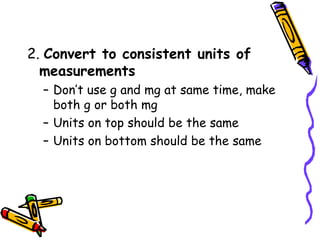
2.  Convert to consistent units of measurements Don’t use g and mg at same time, make both g or both mg Units on top should be the same  Units on bottom should be the same
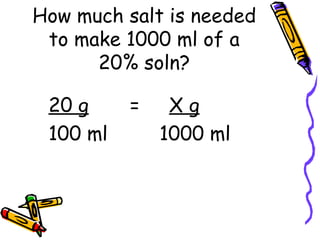
How much salt is needed to make 1000 ml of a 20% soln? 20 g   =  X g 100 ml   1000 ml
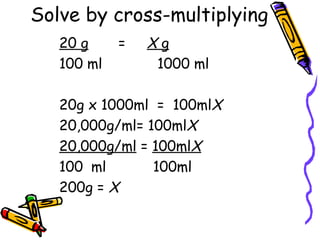
Solve by cross-multiplying 20 g   =  X  g 100 ml   1000 ml 20g x 1000ml  =  100ml X 20,000g/ml= 100ml X 20,000g/ml  =  100ml X 100 ml   100ml 200g =  X
Flexeril comes as 5 mg per tablet. You have an order to give 2.5 mg. How many tablets will you need?
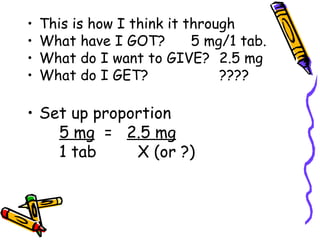
This is how I think it through What have I GOT?  5 mg/1 tab. What do I want to GIVE? 2.5 mg What do I GET? ???? Set up proportion 5 mg   =  2.5 mg 1 tab   X (or ?)
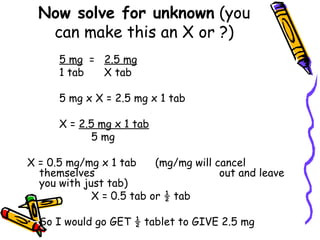
Now solve for unknown  (you can make this an X or ?) 5 mg   =  2.5 mg 1 tab   X tab 5 mg x X = 2.5 mg x 1 tab X =  2.5 mg x 1 tab 5 mg X = 0.5 mg/mg x 1 tab  (mg/mg will cancel themselves  out and leave you with just tab) X = 0.5 tab or ½ tab So I would go GET ½ tablet to GIVE 2.5 mg
Set up ALL drug calculations like this and it is easy,  just make sure same measurements are on top and same measurements are on bottom.  In above example, mg’s both on top and tab’s on bottom.  Doesn’t matter which is on top or bottom as long as the same.
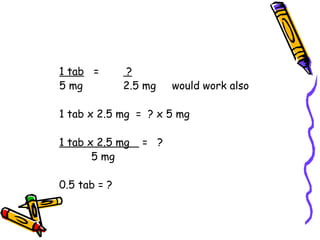
1 tab   =   ? 5 mg 2.5 mg  would work also 1 tab x 2.5 mg  =  ? x 5 mg 1 tab x 2.5 mg  =  ? 5 mg 0.5 tab = ?
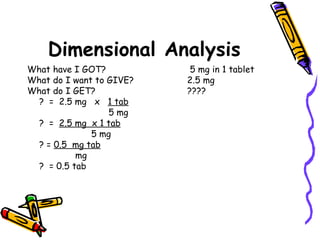
Dimensional Analysis What have I GOT?   5 mg in 1 tablet What do I want to GIVE? 2.5 mg What do I GET? ???? ?  =  2.5 mg  x  1 tab   5 mg ?  =  2.5 mg  x 1 tab   5 mg ? =  0.5  mg tab   mg ?  = 0.5 tab
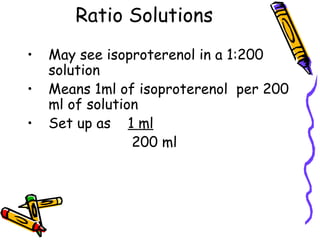
Ratio Solutions May see isoproterenol in a 1:200 solution Means 1ml of isoproterenol  per 200 ml of solution Set up as  1 ml   200 ml
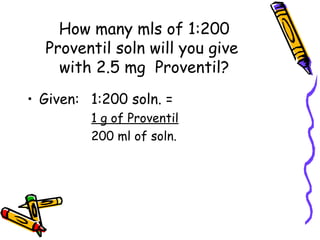
How many mls of 1:200 Proventil soln will you give  with 2.5 mg  Proventil? Given: 1:200 soln. =  1 g of Proventil 200 ml of soln.
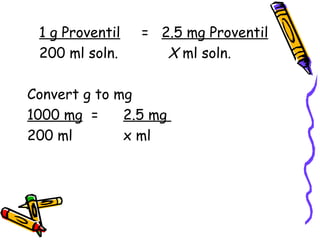
1 g Proventil   =  2.5 mg Proventil 200 ml soln.   X  ml soln. Convert g to mg 1000 mg = 2.5 mg  200 ml x ml
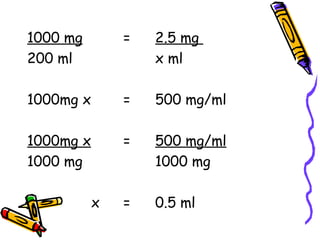
1000 mg = 2.5 mg  200 ml x ml 1000mg x = 500 mg/ml 1000mg x = 500 mg/ml 1000 mg 1000 mg x = 0.5 ml
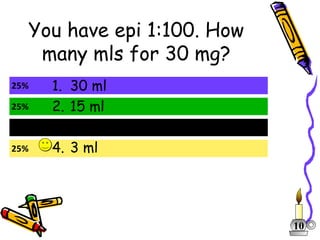
You have epi 1:100. How many mls for 30 mg? 30 ml 15 ml 0.3 ml 3 ml 10
Calculations with a dosage schedule Sometimes the dose of a drug must be obtained from a schedule, which is usually based on the size of the patient.  Most common is weight but sometimes BSA (body surface area).  (p42) The body wt.  must be obtained first, usually in kg then the dose can be calculated.
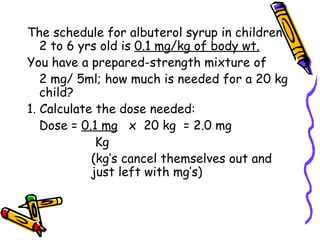
The schedule for albuterol syrup in children 2 to 6 yrs old is  0.1 mg/kg of body wt. You have a prepared-strength mixture of  2 mg/ 5ml; how much is needed for a 20 kg child? 1. Calculate the dose needed: Dose =  0.1 mg   x  20 kg  = 2.0 mg   Kg (kg’s cancel themselves out and  just left with mg’s)
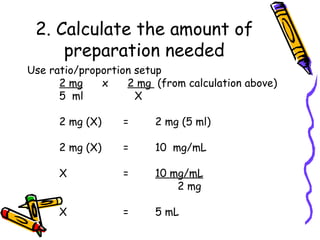
2. Calculate the amount of preparation needed Use ratio/proportion setup 2 mg   x  2 mg  (from calculation above) 5  ml  X 2 mg (X) =  2 mg (5 ml) 2 mg (X)  = 10  mg/mL X = 10 mg/mL   2 mg X  = 5 mL
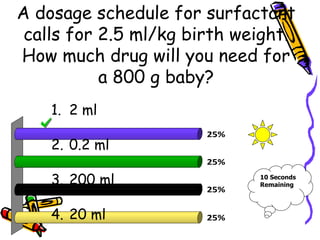
A dosage schedule for surfactant calls for 2.5 ml/kg birth weight. How much drug will you need for a 800 g baby? 2 ml 0.2 ml 200 ml 20 ml 10 Seconds Remaining
 

Res 246 ch 2

  • 1.
    Metric system andDrugDose Calculations Ch 2
  • 2.
    Base Units KiloHecto deca Liter, meter, or gram Deci Centi milli
  • 3.
    Common units ofmeasurements Volume 1 L = 1000 mL 1 mL = 0.001 L Weights 1 Kg = 1000 g 1 g = 0.000 Kg 1 g = 1000 mg 1 mg = 0.001 g
  • 4.
    500 mls isequal to how many liters? 50 5 0.5 2.5
  • 5.
    450 mls isequal to now many liters? 45 0.45 4.5 2
  • 6.
    How many gramsare equal to 50 kg’s? 500 5000 50000 0.05
  • 7.
    How many mlsin 2 liters? 200 0.2 2 2000
  • 8.
    How many kg’sin 3500 gms? 350 35 3.5 0.35
  • 9.
    Drops – onlyuse dropper calibrated specifically for that particular medicine (one from manufacturer) 16 gtts = 1 ml = 1 cc Only use measuring spoons not “eating” spoons 1 tsp = 5 mL 1 Tbs = 15 ml
  • 10.
    1 inch =2.54 cm 2.2 lb = 1 kg 1.06 qt = 1 liter 1 ml = 1 cc (JCAHO recommends using ml though)
  • 11.
    Conversion of unitsFraction method Step 1 Put down starting value, with its units, as a fraction with 1 in denominator i.e. How many kg in 150 lbs? 150 lbs 1
  • 12.
    Step 2 Placeunits you started with in the denominator and put units you want to convert to in numerator with corresponding equivalent values 150 lbs = 1 kg 1 2.2 lbs cancel out lbs; do math 150 = 68.2 kg 2.2
  • 13.
    How many kg’sdoes a 180 lb male weigh? 82 360 100 60
  • 14.
    Your patient is5 ft 8 in. tall. Convert to cm’s 34 150 80 173 10
  • 15.
    Calculating doses from percentage-strength solutions A solution contains a solute, which is dissolved in a solvent. The strength of a solution is expressed in percentage of solute to total solution. The % is the part of the active ingredient (solute) in a 100 mL of the preparation. We usually use a weight to volume type of preparation for respiratory drugs.
  • 16.
    A 20% salinesolution contains 20 g of salt in enough water to make 100 ml of solution A 5% albuteral solution contains 5 ml of albuteral in enough water to make 100 ml of solution
  • 17.
    Calculating with proportions(ratio/proportion method) 1. Set up a proportion Original dose = desired dose per amount per amount
  • 18.
    2. Convertto consistent units of measurements Don’t use g and mg at same time, make both g or both mg Units on top should be the same Units on bottom should be the same
  • 19.
    How much saltis needed to make 1000 ml of a 20% soln? 20 g = X g 100 ml 1000 ml
  • 20.
    Solve by cross-multiplying20 g = X g 100 ml 1000 ml 20g x 1000ml = 100ml X 20,000g/ml= 100ml X 20,000g/ml = 100ml X 100 ml 100ml 200g = X
  • 21.
    Flexeril comes as5 mg per tablet. You have an order to give 2.5 mg. How many tablets will you need?
  • 22.
    This is howI think it through What have I GOT? 5 mg/1 tab. What do I want to GIVE? 2.5 mg What do I GET? ???? Set up proportion 5 mg = 2.5 mg 1 tab X (or ?)
  • 23.
    Now solve forunknown (you can make this an X or ?) 5 mg = 2.5 mg 1 tab X tab 5 mg x X = 2.5 mg x 1 tab X = 2.5 mg x 1 tab 5 mg X = 0.5 mg/mg x 1 tab (mg/mg will cancel themselves out and leave you with just tab) X = 0.5 tab or ½ tab So I would go GET ½ tablet to GIVE 2.5 mg
  • 24.
    Set up ALLdrug calculations like this and it is easy, just make sure same measurements are on top and same measurements are on bottom. In above example, mg’s both on top and tab’s on bottom. Doesn’t matter which is on top or bottom as long as the same.
  • 25.
    1 tab = ? 5 mg 2.5 mg would work also 1 tab x 2.5 mg = ? x 5 mg 1 tab x 2.5 mg = ? 5 mg 0.5 tab = ?
  • 26.
    Dimensional Analysis Whathave I GOT? 5 mg in 1 tablet What do I want to GIVE? 2.5 mg What do I GET? ???? ? = 2.5 mg x 1 tab 5 mg ? = 2.5 mg x 1 tab 5 mg ? = 0.5 mg tab mg ? = 0.5 tab
  • 27.
    Ratio Solutions Maysee isoproterenol in a 1:200 solution Means 1ml of isoproterenol per 200 ml of solution Set up as 1 ml 200 ml
  • 28.
    How many mlsof 1:200 Proventil soln will you give with 2.5 mg Proventil? Given: 1:200 soln. = 1 g of Proventil 200 ml of soln.
  • 29.
    1 g Proventil = 2.5 mg Proventil 200 ml soln. X ml soln. Convert g to mg 1000 mg = 2.5 mg 200 ml x ml
  • 30.
    1000 mg =2.5 mg 200 ml x ml 1000mg x = 500 mg/ml 1000mg x = 500 mg/ml 1000 mg 1000 mg x = 0.5 ml
  • 31.
    You have epi1:100. How many mls for 30 mg? 30 ml 15 ml 0.3 ml 3 ml 10
  • 32.
    Calculations with adosage schedule Sometimes the dose of a drug must be obtained from a schedule, which is usually based on the size of the patient. Most common is weight but sometimes BSA (body surface area). (p42) The body wt. must be obtained first, usually in kg then the dose can be calculated.
  • 33.
    The schedule foralbuterol syrup in children 2 to 6 yrs old is 0.1 mg/kg of body wt. You have a prepared-strength mixture of 2 mg/ 5ml; how much is needed for a 20 kg child? 1. Calculate the dose needed: Dose = 0.1 mg x 20 kg = 2.0 mg Kg (kg’s cancel themselves out and just left with mg’s)
  • 34.
    2. Calculate theamount of preparation needed Use ratio/proportion setup 2 mg x 2 mg (from calculation above) 5 ml X 2 mg (X) = 2 mg (5 ml) 2 mg (X) = 10 mg/mL X = 10 mg/mL 2 mg X = 5 mL
  • 35.
    A dosage schedulefor surfactant calls for 2.5 ml/kg birth weight. How much drug will you need for a 800 g baby? 2 ml 0.2 ml 200 ml 20 ml 10 Seconds Remaining
  • 36.